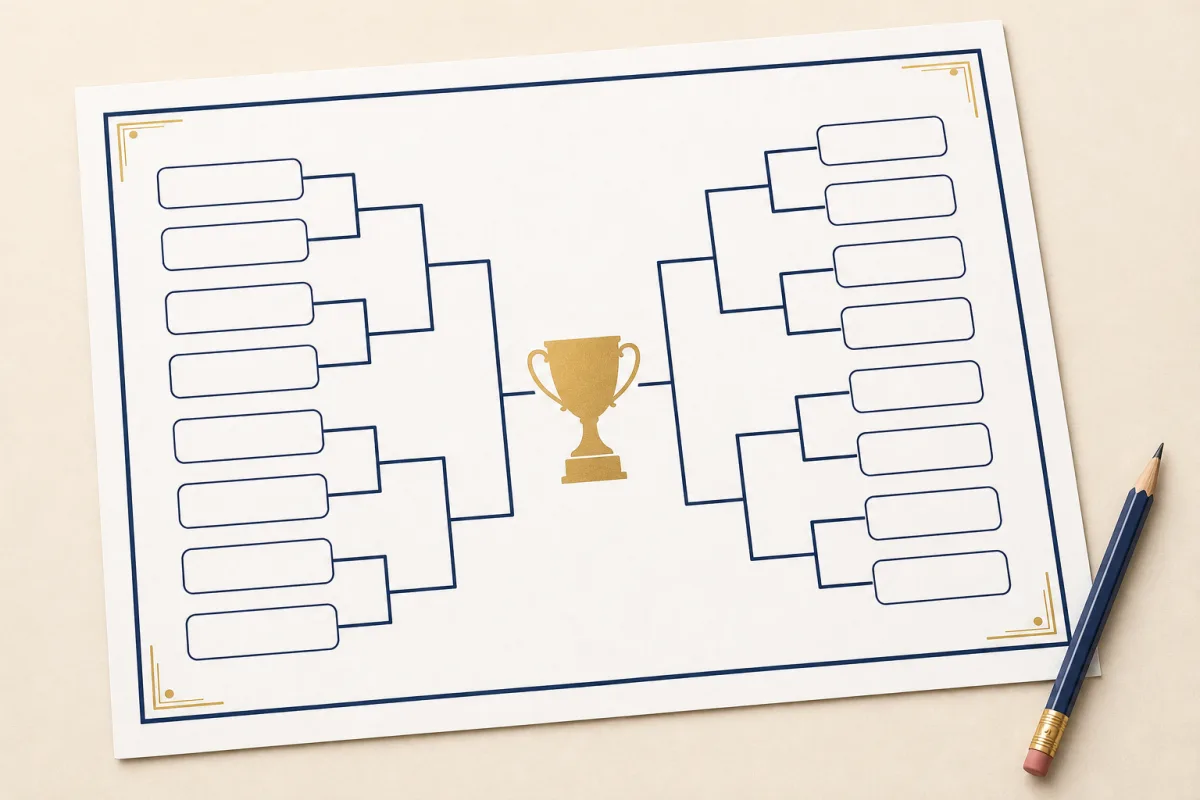
A 16-team bracket for single elimination has four rounds: the opening round, quarterfinals, semifinals, and a championship match. It starts with sixteen entrants, reduces to eight, then four, then two, leaving one champion; that requires fifteen matches when every slot is filled. Source (accessed 2026-10-30)
Use a blank bracket when you want to write names and scores by hand. Choose a fillable version when you need to type entries before printing or saving. For a live event, a digital bracket is usually easier to update and share—provided the tool offers the export or sharing option you need. Brakora is a tournament bracket-maker app; review its current options before choosing your final workflow. Source (accessed 2026-10-30)
Build a seeded 16-team bracket
Seeding is a way to place entrants so the highest seeds are separated early in the tournament. A common seeded arrangement places Seed 1 against Seed 16, Seed 8 against Seed 9, Seed 5 against Seed 12, Seed 4 against Seed 13, Seed 6 against Seed 11, Seed 3 against Seed 14, Seed 7 against Seed 10, and Seed 2 against Seed 15 in the opening round. Source (accessed 2026-10-30)
- Put your strongest entrant at Seed 1 and continue through Seed 16 using standings, a ranking method, qualifying results, or an agreed random draw.
- Enter the eight opening matchups in the order below.
- After each result, write the winner into the connected slot in the next round.
- Record the score beside the completed matchup, then confirm that the correct winner advances before announcing the next game.
- Seed 1 vs. Seed 16
- Seed 8 vs. Seed 9
- Seed 5 vs. Seed 12
- Seed 4 vs. Seed 13
- Seed 6 vs. Seed 11
- Seed 3 vs. Seed 14
- Seed 7 vs. Seed 10
- Seed 2 vs. Seed 15
This order is useful because it gives every organizer, player, and spectator a consistent reference point. It is not the only defensible approach: for a casual office pool, game night, or social event, random placement may be more appropriate. Decide the method before names go into the bracket, and keep a note of it with the event rules.
Follow winners through the four rounds
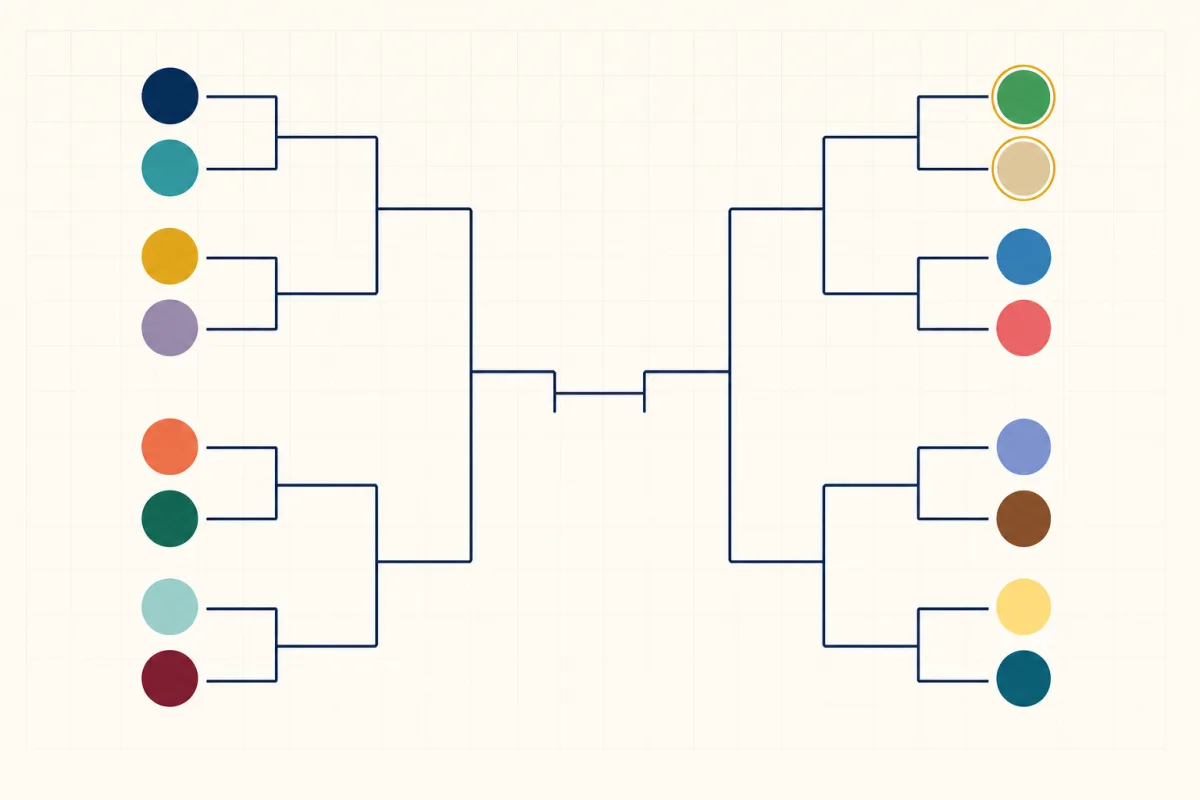
In a single-elimination bracket, a loss ends that entrant’s run. The winner of the first opening matchup plays the winner of the second opening matchup in the first quarterfinal. Continue the same left-to-right progression for each connected pair, then advance quarterfinal winners to the semifinals and semifinal winners to the championship. A single-elimination tournament has one loss-to-elimination path by design. Source (accessed 2026-10-30)
A practical score-entry routine is simple:
- Confirm the two entrants and the scheduled match.
- Write or type the final score in that matchup.
- Advance only the winner to the directly connected next-round line.
- Check the next matchup against the bracket before publishing it.
That final check matters most when several games finish close together. On paper, use a dark pen and avoid overwriting a result. In a digital version, save or share the updated bracket after each group of completed matches, so participants are looking at the same current version.
Choose blank, printable, fillable, or online use
The best format depends less on the sport or activity than on how people will use the bracket.
- Blank printable bracket: Best for a wall, check-in table, classroom, or event where one organizer records results by hand.
- Fillable bracket: Best when names and scores should be typed before printing, emailing, or saving as a file.
- PDF or image export: Useful when recipients need a fixed snapshot that will not change after it is sent. Check that names remain readable at the size people will view or print.
- Online bracket: Useful when organizers need to update results and send participants to a current shared view. Confirm access, editing permissions, and sharing controls before the event begins.
If you want to start digitally, use the free tournament bracket generator to begin your setup, then choose the output and sharing method that fits your event. For a broader feature checklist, see what to compare in a free bracket builder.
What to do with fewer than 16 entrants
You can still use a sixteen-slot bracket when the field is smaller. Leave the necessary opening slots empty and treat the opposing entrants as receiving byes into the next round. Place byes deliberately rather than scattering them: in a seeded event, they normally protect the highest seeds; in a random event, assign them using the same transparent draw method used for the rest of the field.
Before play starts, tell participants whether empty slots are byes, forfeits, or placeholders for late qualifiers. A bye is not a played result, so do not enter an invented score for it. Advance the eligible entrant to the next connected matchup and make the status clear on the printed or shared version.
Single elimination or double elimination?
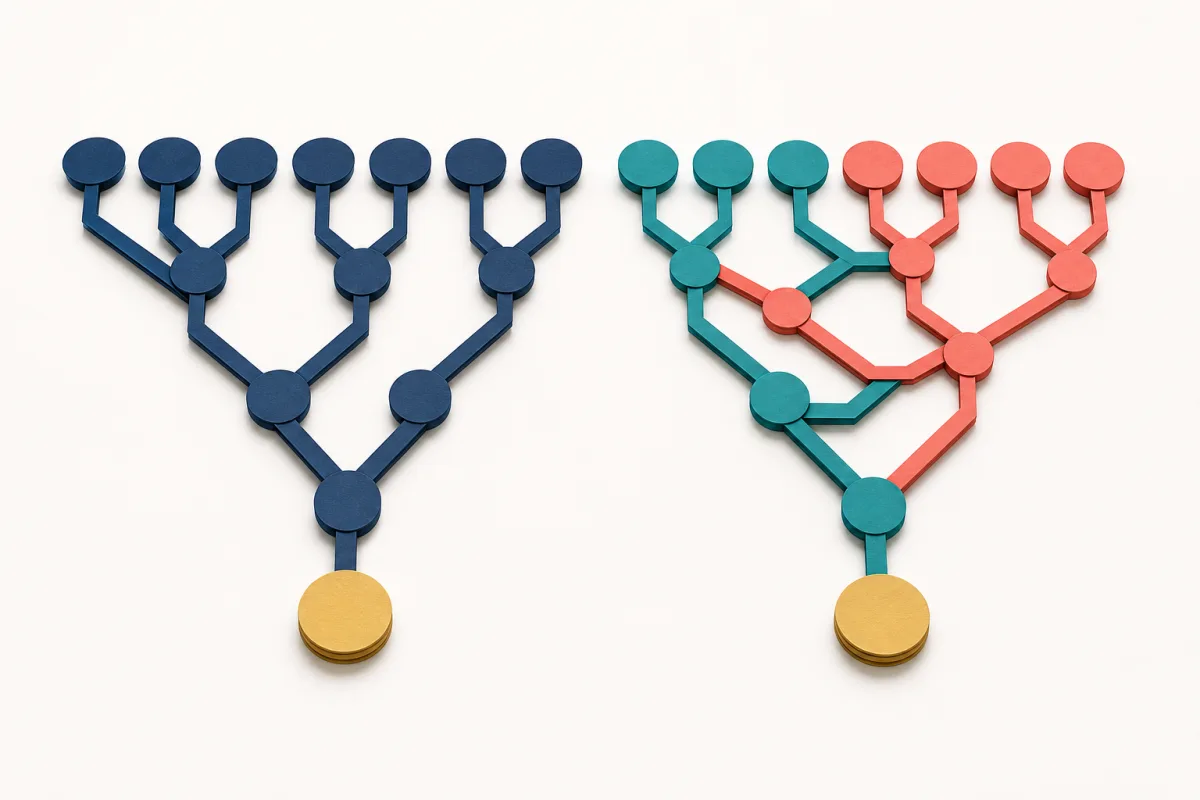
Choose single elimination when you need a compact event with a direct path to a champion: one loss eliminates an entrant. Choose double elimination when you want entrants to have another route after an initial loss; that format uses a winners bracket and a losers bracket, so it needs more scheduling and result tracking. Source (accessed 2026-10-30)
Do not use a single-elimination sheet and quietly add a second-chance rule halfway through. The advancement paths differ. If a second-loss format is what your group expects, start with a dedicated double-elimination bracket explanation and set the rules before the first matchup.
Quick event checklist
- Confirm the entrant list and whether any names are still provisional.
- Choose seeded or random placement and communicate it before the draw.
- Decide how ties, forfeits, late arrivals, and byes will be handled.
- Prepare a readable printed copy or a single shared digital version.
- Record each finished score, advance the winner, and verify the next matchup.
- Keep the final bracket as the event record once a champion is decided.
Can I use this format for non-sports matchups?
Yes. A single-elimination bracket works for games, voting rounds, workplace challenges, classroom activities, food polls, and other head-to-head comparisons. Define what determines a winner before the bracket starts.
Should I seed teams or draw them at random?
Seed when prior performance, rankings, or qualifying results should influence placement. Draw randomly when equal treatment and surprise are more important than competitive balance. State the approach in advance.
What should I share with participants?
Share the bracket version, match times or deadlines, the rules for results and ties, and one reliable place where updates will appear. A current link is often easier to manage than multiple screenshot copies.