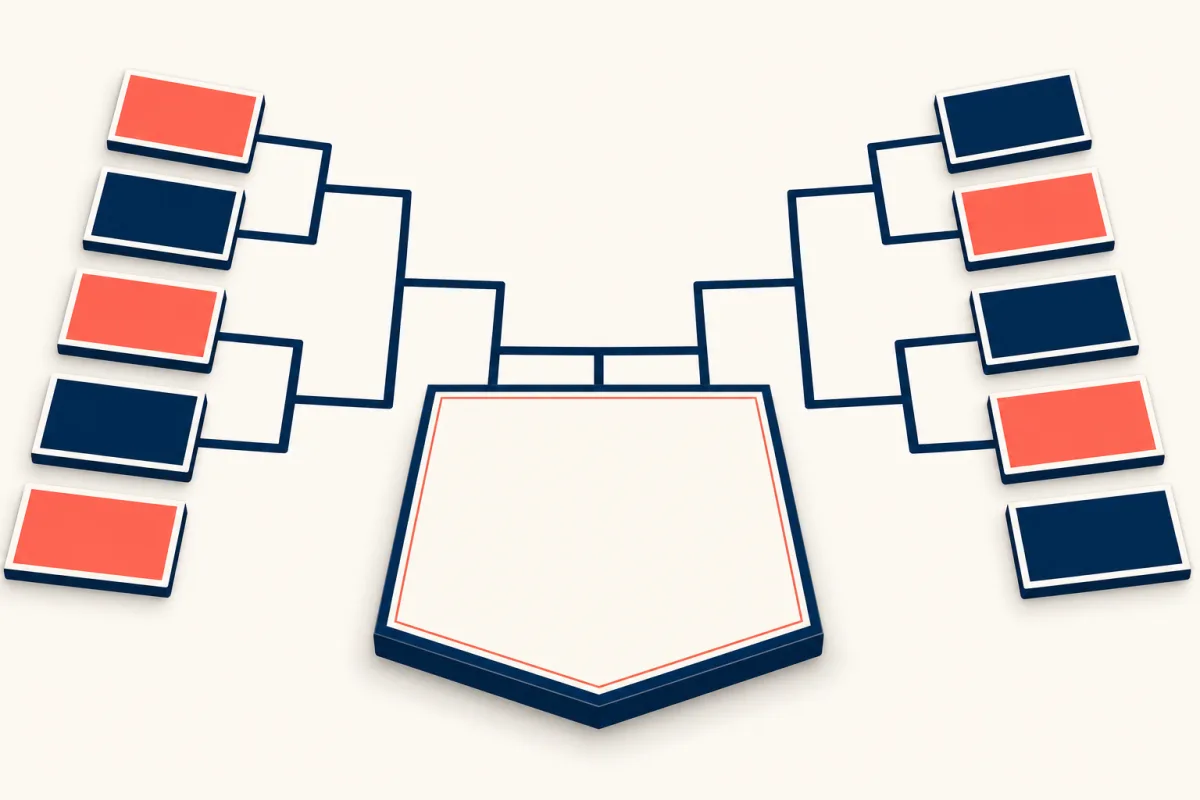
A 10-team single-elimination tournament bracket starts with two opening matchups, then moves into quarterfinals, semifinals, and a championship. The cleanest seeded setup gives the top seeds byes and lets the lowest seeds play their way into the quarterfinal field. Source (accessed 2026-11-20)
Your usable 10-team bracket layout
Write team names into the slots below, then enter each winner in the next listed matchup. This version is seeded: lower seed numbers represent stronger placement.
Opening matchups
- Seed 8 vs Seed 9 → winner advances to face Seed 1.
- Seed 7 vs Seed 10 → winner advances to face Seed 2.
Quarterfinal paths
- Seed 1 vs winner of Seed 8/Seed 9.
- Seed 4 vs Seed 5.
- Seed 3 vs Seed 6.
- Seed 2 vs winner of Seed 7/Seed 10.
Finish the bracket
- The winners of the first two quarterfinal paths meet in one semifinal.
- The winners of the remaining quarterfinal paths meet in the other semifinal.
- The semifinal winners meet for the championship.
A 10-team single-elimination bracket can be arranged from a 16-slot knockout structure: 2 opening games reduce the field to 8, followed by 4 quarterfinals, 2 semifinals, and 1 championship game, for 9 games across 4 rounds. A seeded layout can use first-round pairings 8 vs 9 and 7 vs 10, then quarterfinal pairings 1 vs winner of 8/9, 4 vs 5, 3 vs 6, and 2 vs winner of 7/10. Source (accessed 2026-11-20)
Why the byes belong with the strongest seeds
A bracket is easiest to run when every later round has a full, even set of matchups. With ten entrants, the opening games reduce the field before the quarterfinals. In a seeded event, placing the byes with the highest seeds rewards results earned before the tournament and keeps the strongest teams apart until later, assuming they keep advancing.
Do not put both opening-game winners on the same side of the bracket. That can force one portion of the draw to do more work than the other before the semifinal stage. The layout above sends each opening-game winner toward a different top seed, which preserves a balanced route to the final.
Seeded, random, or partly seeded: choose the rule before drawing
- Seeded draw: Best when league standings, qualifying results, or prior performance provide a defensible order. Publish the seeding rule before the draw, especially if byes are involved.
- Random draw: Useful for a casual event where equal treatment matters more than separating stronger entrants. Draw the opening slots and bye positions openly so participants can follow the process.
- Partly seeded draw: Useful when a small group of teams must be separated but the remaining field can be drawn at random. State which placements are protected and which are random.
If there is no credible ranking, a transparent random draw is generally better than inventing seeds after teams have arrived. If the event has standings or qualification rules, use the seeded layout and document the source of the order.
Choose the bracket workflow that matches the event
Paper-first bracket: This is good for a gym, club room, or event desk where people need to see changes at a glance. It is quick to post, but handwriting corrections can become messy and copies drift out of date.
Editable document: This suits an organizer who needs clean names, dates, venues, and score lines before printing. It is easier to revise than paper, but someone still needs to maintain the current version and distribute it.
Online bracket: This is the better fit when participants need a shared current view rather than a photograph of a wall chart. It reduces duplicate versions, but it depends on a clear updating routine and access for the people who need it.
For most organized events, the best choice is an editable master plus a print-friendly copy for the venue. If live sharing matters, begin with Brakora’s bracket generator and keep one person responsible for entering results. The App Store product page identifies the product as “Bracket Maker: Brakora.” Source (accessed 2026-11-20)
Fill it in without creating avoidable confusion
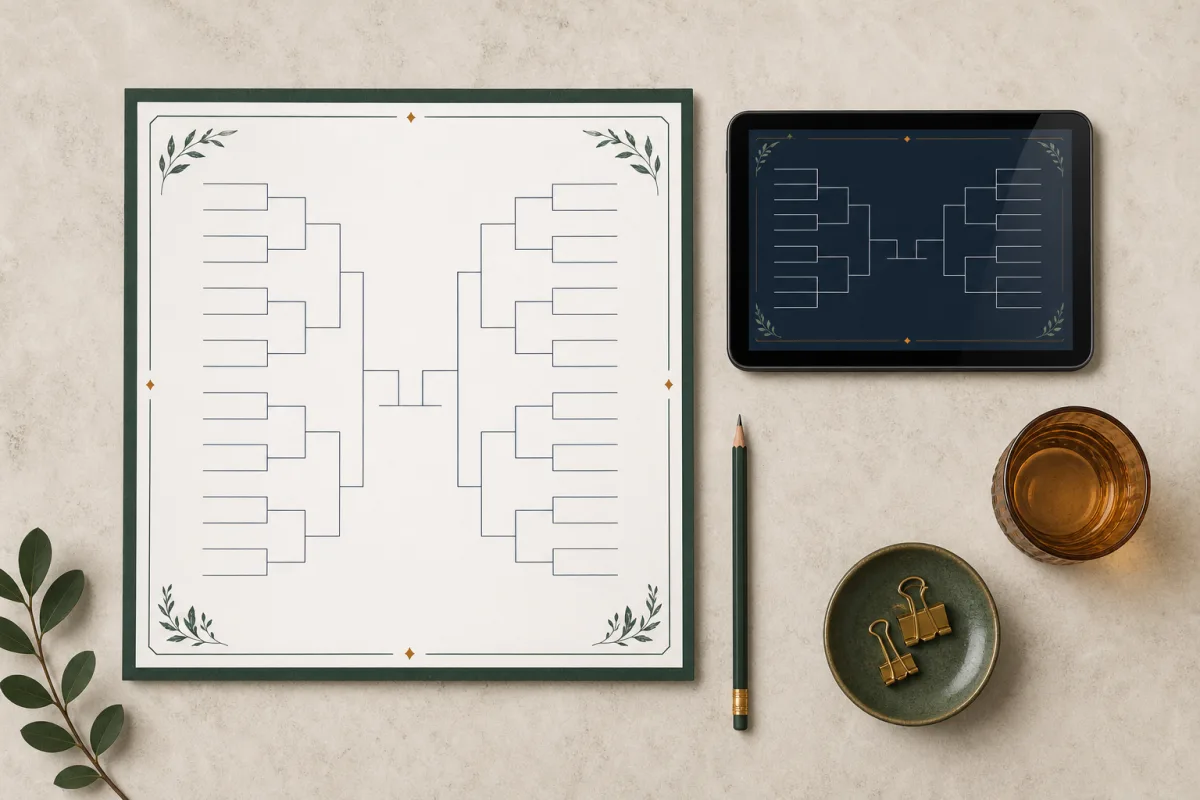
- Put the event name at the top, then add the date and venue where players can see them.
- Enter the teams in the selected seed order or in the order produced by the draw.
- Add scheduled time and playing location beside every live matchup, rather than only at the top of the page.
- After each result, write the score, mark the winner, and advance that same team into the next open slot.
- Share the updated bracket after each round so participants are not relying on an old screenshot or printout.
For a PDF-friendly version, leave enough room beside each matchup for names and scores before printing. If you are working digitally, save the filled version under an event-specific name before making later changes. That gives the organizer a stable record without turning an old bracket into the current one.
Scheduling the rounds without overpacking the day
The two opening games can be played at the same time if you have separate playing areas. The quarterfinals cannot begin until their relevant opening-game winners are known; the other quarterfinals may be scheduled independently. Build recovery time into the route for teams that begin in an opening matchup, because they may need to play again sooner than teams receiving byes.
When space is limited, a single-elimination format is attractive because every result advances the event. When guaranteed participation matters more than speed, consider a different structure before publishing the schedule. A round-robin schedule gives teams repeated fixtures, while a double-elimination bracket is a separate format with a different path through the event.
Mistakes that make a short bracket feel unfair
- Assigning byes after the draw: This invites arguments because a bye changes a team’s route. Decide whether placement is seeded or random before names go into slots.
- Using a generic bracket with too many empty places: Empty slots obscure who actually plays first. Mark the two opening matchups and the bye paths clearly.
- Advancing a winner into the wrong side: One mistaken line can change several later matchups. Keep the progression labels visible and update only from the completed game.
- Publishing times without locations: Participants may know when to play but not where. Put the venue or court information next to each matchup.
Add-ons that should stay separate from the main draw
A consolation game can be added for the losing semifinalists if you want an additional placement game. Label it separately from the championship path so no one mistakes it for part of the single-elimination title bracket.
If the goal is to give teams more than one chance after a loss, do not quietly bolt extra games onto this chart. Choose a double-elimination format from the outset; it needs its own winners’ and losers’ paths. For a larger power-of-two field without byes, see this 16-team bracket setup.
What to keep in mind before you publish the bracket
- A ten-team single-elimination field works cleanly when two opening games feed an eight-team quarterfinal stage.
- Use seeding when there is a published basis for it; otherwise, make the random draw visible and consistent.
- Keep names, scores, times, and locations close to the matchup they belong to, not in a separate note.
- Maintain one current version of the bracket, whether it is posted on paper, shared digitally, or both.
- Label any consolation or double-elimination option separately so the championship route remains unambiguous.
How many games are in a 10-team single-elimination tournament?
There are 9 games: 2 opening games, 4 quarterfinals, 2 semifinals, and 1 championship game. Source (accessed 2026-11-20)
Can I make this bracket random instead of seeded?
Yes. Draw teams into the same positions at random, including the opening-game paths and bye positions. Explain the process before the draw so participants understand how the bracket was formed.
Can I print the bracket or save it as a PDF?
Yes. Prepare the bracket with room for team names, scores, dates, times, and locations, then use your device’s print options for a paper or PDF copy.